
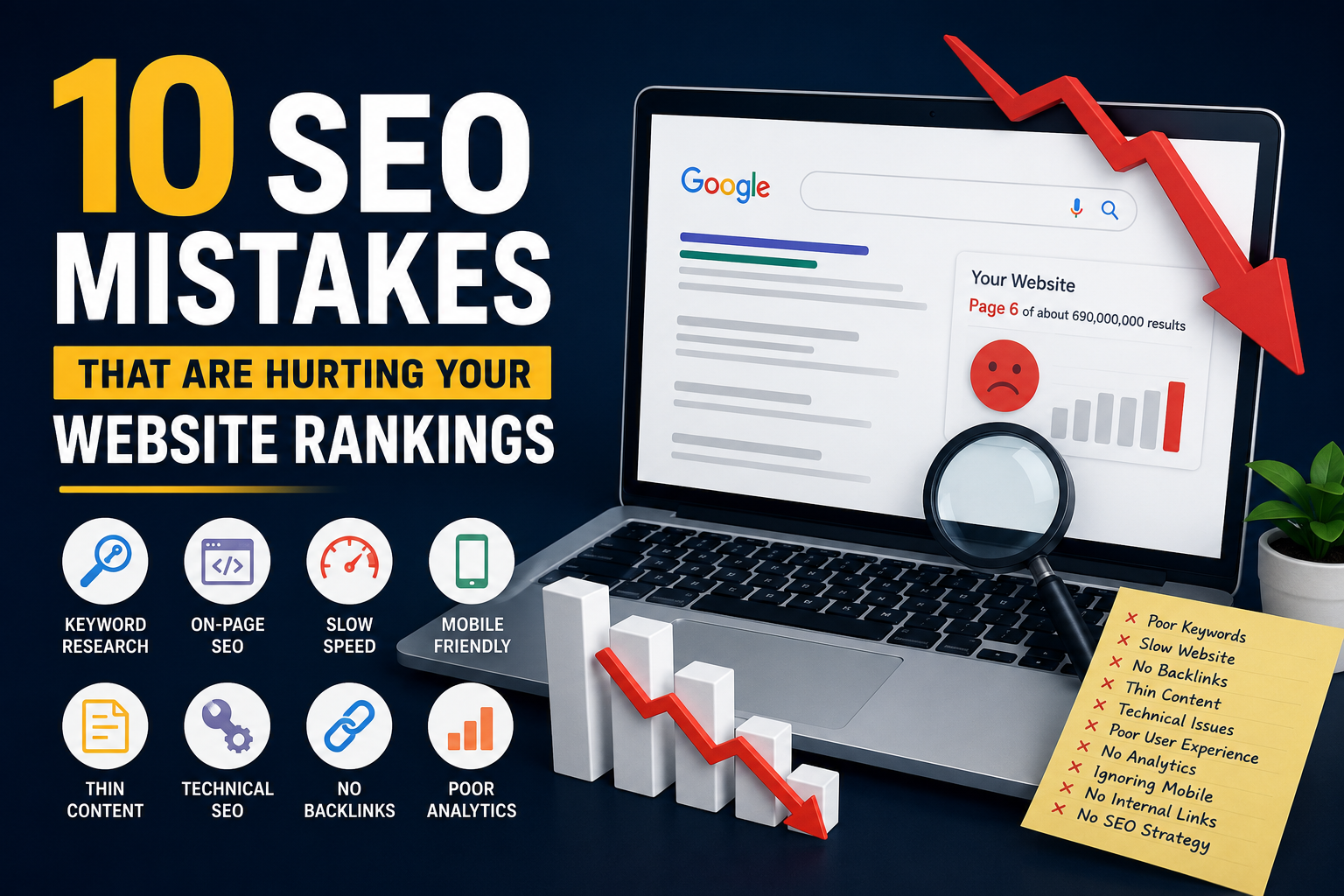
10 SEO Mistakes That Are Hurting Your Website Rankings
10 SEO Mistakes That Are Hurting Your Website Rankings
Getting your website on the first page of Google doesn’t happen by chance. It takes the right SEO strategy, consistent effort, and a focus on providing value to your audience. However, even well-designed websites can struggle to rank because of common SEO mistakes that often go unnoticed.
If your website isn’t attracting the organic traffic you expected, one or more of these mistakes could be the reason. Let’s look at the 10 most common SEO mistakes and how you can fix them.
1. Ignoring Keyword Research
Creating content without proper keyword research is like trying to reach a destination without a map. If you’re targeting the wrong keywords, your audience may never find your content.
How to fix it:
- Research keywords before writing.
- Focus on long-tail keywords with clear search intent.
- Use keywords naturally throughout your content.
2. Poor On-Page SEO
Many websites publish great content but forget the basics of on-page SEO. Missing title tags, poorly written meta descriptions, and incorrect heading structures make it difficult for search engines to understand your pages.
How to fix it:
- Write unique title tags and meta descriptions.
- Use one H1 heading and organize content with H2 and H3 headings.
- Include keywords naturally without overusing them.
3. Slow Website Speed
A slow-loading website creates a poor user experience and can negatively affect your search rankings. Visitors are more likely to leave if a page takes too long to load.
How to fix it:
- Compress large images.
- Remove unnecessary plugins.
- Enable caching.
- Choose a reliable hosting provider.
4. Not Optimizing for Mobile Devices
With most users browsing on their smartphones, a mobile-friendly website is essential. Google also uses mobile-first indexing, meaning it primarily evaluates the mobile version of your website.
How to fix it:
- Use a responsive website design.
- Test your website on different devices.
- Ensure buttons, images, and text display correctly on smaller screens.
5. Publishing Thin or Low-Quality Content
Google rewards content that genuinely helps users. Articles that are too short, copied from other websites, or lacking useful information are less likely to rank well.
How to fix it:
- Create original, informative content.
- Answer common user questions.
- Update older blog posts regularly to keep them relevant.
6. Ignoring Technical SEO
Technical SEO ensures that search engines can crawl and index your website efficiently. Problems such as broken links, missing XML sitemaps, or crawl errors can affect your visibility.
How to fix it:
- Submit an XML sitemap.
- Fix broken links and 404 errors.
- Use HTTPS.
- Review your website in Google Search Console.
7. Missing Internal Links
Internal linking helps users discover related content while helping search engines understand your website’s structure. Many websites miss this simple but effective SEO practice.
How to fix it:
- Link to relevant blog posts and service pages.
- Use descriptive anchor text.
- Build a logical content structure.
8. Neglecting Image SEO
Images can improve user experience, but they also need optimization. Large file sizes and missing alt text can slow down your website and reduce accessibility.
How to fix it:
- Compress images before uploading.
- Use descriptive file names.
- Add relevant alt text to every image.
9. Forgetting to Track SEO Performance
Without monitoring your website’s performance, it’s difficult to know what’s working and what needs improvement.
How to fix it:
- Use Google Search Console to monitor indexing and search performance.
- Track website traffic using Google Analytics.
- Review keyword rankings regularly.
10. Expecting Instant Results
SEO isn’t a one-time task or a quick fix. Many website owners become discouraged after a few weeks without seeing significant improvements.
The reality is that SEO is a long-term strategy. Consistent effort, quality content, and regular optimization lead to sustainable growth over time.
How to fix it:
- Publish content consistently.
- Monitor your website’s progress.
- Continue improving your SEO strategy based on performance.
Final Thoughts
SEO success doesn’t come from shortcuts—it comes from building a website that provides value to users while following search engine best practices. By avoiding these common SEO mistakes and making continuous improvements, you can increase your website’s visibility, attract more organic traffic, and achieve better Google rankings.
Remember, every small improvement adds up. Start by fixing one issue at a time, and over time, you’ll build a stronger, more search-friendly website.
**SEO is a long-term investment, but the results are worth it. If your business needs a stronger online presence, I’m here to help. As a **Freelance Digital Marketer in Kochi, I focus on practical, results-driven SEO strategies that improve visibility and drive sustainable growth.
Getting your website on the first page of Google doesn’t happen by chance. It takes the right SEO strategy, consistent effort, and a focus on providing value to your audience. However, even well-designed websites can struggle to rank because of common SEO mistakes that often go unnoticed.
If your website isn’t attracting the organic traffic you expected, one or more of these mistakes could be the reason. Let’s look at the 10 most common SEO mistakes and how you can fix them.
1. Ignoring Keyword Research
Creating content without proper keyword research is like trying to reach a destination without a map. If you’re targeting the wrong keywords, your audience may never find your content.
How to fix it:
- Research keywords before writing.
- Focus on long-tail keywords with clear search intent.
- Use keywords naturally throughout your content.
2. Poor On-Page SEO
Many websites publish great content but forget the basics of on-page SEO. Missing title tags, poorly written meta descriptions, and incorrect heading structures make it difficult for search engines to understand your pages.
How to fix it:
- Write unique title tags and meta descriptions.
- Use one H1 heading and organize content with H2 and H3 headings.
- Include keywords naturally without overusing them.
3. Slow Website Speed
A slow-loading website creates a poor user experience and can negatively affect your search rankings. Visitors are more likely to leave if a page takes too long to load.
How to fix it:
- Compress large images.
- Remove unnecessary plugins.
- Enable caching.
- Choose a reliable hosting provider.
4. Not Optimizing for Mobile Devices
With most users browsing on their smartphones, a mobile-friendly website is essential. Google also uses mobile-first indexing, meaning it primarily evaluates the mobile version of your website.
How to fix it:
- Use a responsive website design.
- Test your website on different devices.
- Ensure buttons, images, and text display correctly on smaller screens.
5. Publishing Thin or Low-Quality Content
Google rewards content that genuinely helps users. Articles that are too short, copied from other websites, or lacking useful information are less likely to rank well.
How to fix it:
- Create original, informative content.
- Answer common user questions.
- Update older blog posts regularly to keep them relevant.
6. Ignoring Technical SEO
Technical SEO ensures that search engines can crawl and index your website efficiently. Problems such as broken links, missing XML sitemaps, or crawl errors can affect your visibility.
How to fix it:
- Submit an XML sitemap.
- Fix broken links and 404 errors.
- Use HTTPS.
- Review your website in Google Search Console.
7. Missing Internal Links
Internal linking helps users discover related content while helping search engines understand your website’s structure. Many websites miss this simple but effective SEO practice.
How to fix it:
- Link to relevant blog posts and service pages.
- Use descriptive anchor text.
- Build a logical content structure.
8. Neglecting Image SEO
Images can improve user experience, but they also need optimization. Large file sizes and missing alt text can slow down your website and reduce accessibility.
How to fix it:
- Compress images before uploading.
- Use descriptive file names.
- Add relevant alt text to every image.
9. Forgetting to Track SEO Performance
Without monitoring your website’s performance, it’s difficult to know what’s working and what needs improvement.
How to fix it:
- Use Google Search Console to monitor indexing and search performance.
- Track website traffic using Google Analytics.
- Review keyword rankings regularly.
10. Expecting Instant Results
SEO isn’t a one-time task or a quick fix. Many website owners become discouraged after a few weeks without seeing significant improvements.
The reality is that SEO is a long-term strategy. Consistent effort, quality content, and regular optimization lead to sustainable growth over time.
How to fix it:
- Publish content consistently.
- Monitor your website’s progress.
- Continue improving your SEO strategy based on performance.
Final Thoughts
SEO success doesn’t come from shortcuts—it comes from building a website that provides value to users while following search engine best practices. By avoiding these common SEO mistakes and making continuous improvements, you can increase your website’s visibility, attract more organic traffic, and achieve better Google rankings.
Remember, every small improvement adds up. Start by fixing one issue at a time, and over time, you’ll build a stronger, more search-friendly website.
**SEO is a long-term investment, but the results are worth it. If your business needs a stronger online presence, I’m here to help. As a **Freelance Digital Marketer in Kochi, I focus on practical, results-driven SEO strategies that improve visibility and drive sustainable growth.